


The process of awakening is a remarkable experience when doing it alone, but it seems to me that having a teacher allows a person to truly understand the experience and experience it fully.



Summary of the Chapter
The exploration and experience of well-being is most commonly confined to what research has found makes the difference: conducive life conditions, along with positive thoughts and feelings about those conditions.
However, we can also approach well-being in a very different way. In an alternative model – nondual well-being, happiness is seen to be derived from a different set of causes—an inner experience independent of life conditions.
This introductory chapter looks at the impact that such a shift in how we approach well-being can have across different fields.
To access the free online version of the chapter go to https://www.intechopen.com/chapters/1196709
Summary of the Chapter
The journey to actualise our full potential is a complex one but there is research to suggest it is marked with signs along the way. Following an investigation of the literature, a theoretical framework made up of five major stages and their markers is proposed.
It is suggested that in Stage 1, the conventional sense of self, well-being pivots on the experiences of pleasure and pain. In Stage 2 (Mindfulness) a new level of nonjudgmental objectivity develops where thoughts can be seen as passing mental events.
With practice, Stage 3 awakening events may occur, leading to an interruption of the sense of a continuous self. Over time, these intermittent states may stabilise, leaving a default of the ongoing awakened state of Stage 4, an altruistic, peaceful resting state with no discernible sense of self, and increased functionality.
Finally, after a seemingly infinite amount of practice, the rare uninterrupted blissful state of perfected enlightenment, along with unlimited capacities, occurs (Stage 5).
With the increase now in evidence-based mindfulness research, we are able to evaluate the psychology of enlightenment and its associated stages. If we can translate methods and outcomes into psychological language and find common ground with western concepts of happiness and human potential, we may find antidotes to our mental health inquiry, that can raise the bar from coping to contentment.
To access the free online version of the chapter go to https://www.intechopen.com/chapters/1196707






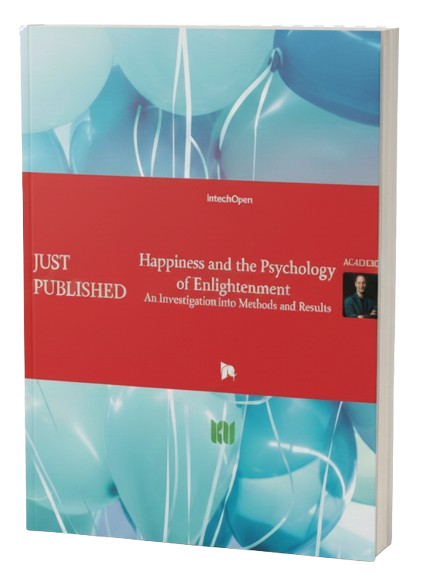
Happiness, now commonly also referred to as well-being is usually derived from how we think and feel about our life conditions. When they go down, we usually feel distressed and problem solve ways to bring them back up to baseline, so we can feel good again. Enlightenment is an alternative experience of well-being which is not sourced from this process but is a natural resting state that produces happiness or well-being spontaneously. Here we do not need our life conditions to be a certain way to feel good. Which of course is a psychologically robust way to live.
Such an approach is traditionally found within religion and spirituality, however it is dressed in different clothes depending on the discipline. As a non-religious or secular approach to happiness has increasingly been embraced in the mainstream, there is a need to examine these different approaches and translate them back into usable methods and results.
In this volume, authors from around the world and from different disciplines present their approach to enlightenment. Whilst diverse, they seem to arrive, as expected, at a place that is common to all.
Chapter 1, Introductory chapter: The paradigm shift from Event-Based Well-Being to Nondual Well-Being, introduces the difference between conventional well-being and enlightenment, the relevance of the different pathways to achieve it, and its application to modern society.
In Chapter 2, Psychological Stages of Enlightenment, following a summary of the range of methods and results found across major religious and secular approaches, a framework of the path to enlightenment, made up of five major stages and their markers is proposed.
Chapter 3, Enlightenment and the Psychology of Self-Transcendence: Pathways to Fundamental Well-being and Prosocial Behaviour explores the notion of enlightenment and critically evaluates practices that facilitate these states. It examines empirical studies that implement nondual practices and assesses their role in well-being.
In Chapter 4, The Realisation of Emptiness in Zen Satori – a narrative review, enlightenment states, or satori, are explored within the Buddhist Zen tradition including the boundaries between self and nonself, the bliss of “attaining” or reaching supreme states of oneness, union or a dissolution of a concrete identity or sense of “self.”
In Chapter 5, Enlightened Joy and Love, Selflessness and Beyond, the concept of enlightenment as a stable and enduring plateau state is explored with a study of 32 exemplars from various traditions. The researcher identifies key characteristics of this state. including a sustained sense of well-being and connectedness that transcends the fluctuating emotions of ordinary consciousness.
The research in Chapter 6, Perspective Chapter: Contemplation – A Symbiotic Approach to Esthetic Presence, explores the connection between contemplation and self-realization, through an interdisciplinary lens that includes philosophy, psychology, and spirituality. Tracing its origins from classical Greek philosophy to ancient Eastern approaches to modern thought, it investigates how contemplative practices such as engaging with beauty in art or nature can lead to self-awareness.
Chapter 7, Perspective Chapter: Literary Reading as a Pathway to Enlightenment and Eudaimonic Flourishing, presents a Christian view of enlightenment and includes the notion that embracing suffering is an essential purifying component of the path to such flourishing. Proposing a Christian form of enlightenment to include heightened awareness of God’s presence; apprehension of God as Beloved, and a renunciation of self-orientation, it examines the poetry of Fr George Herbert and Saint John of the Cross and how literary reading, can be a pathway towards enlightenment and eudaimonic flourishing.
In Chapter 8, Forgiveness: Practicing Inner Peace, the psychological study of forgiveness and its role in mental health and well-being is explored, along with a review of psychological theory and models of clinical intervention. The researcher examines how the compassion of forgiveness can support an individual’s quest for inner peace when suffering from unjust emotional injury.
Chapter 9, Yoga and Religion in the Quest for Happiness and Enlightenment, draws from The Yoga Sutras of Patanjali and their eightfold path or method, and investigates the role of yoga within religious contexts as a path to enlightenment and well-being. Synthesising theoretical perspectives and empirical findings of the spiritual and psychological benefits of yoga, it discusses the evolution of yoga practices and their contemporary implications.
Chapter 10, The Neuroscience of Psychological Well-Being and Flourishing, completes the volume and highlights current literature around how neuroscience informs the conditions necessary for psychological well-being and flourishing. Three conditions, mindfulness, compassion, and creativity are identified as foundational components for enlightenment, and the chapter explores their neuro-underpinnings and role in cultivating optimal human flourishing.